People searching for Salesforce alternatives often start with “which CRM can replace Salesforce?” But that question may come too early. Before comparing products, determine whether the company actually needs another CRM or whether CRM has become the general application platform used to implement processes far beyond sales and customer management.
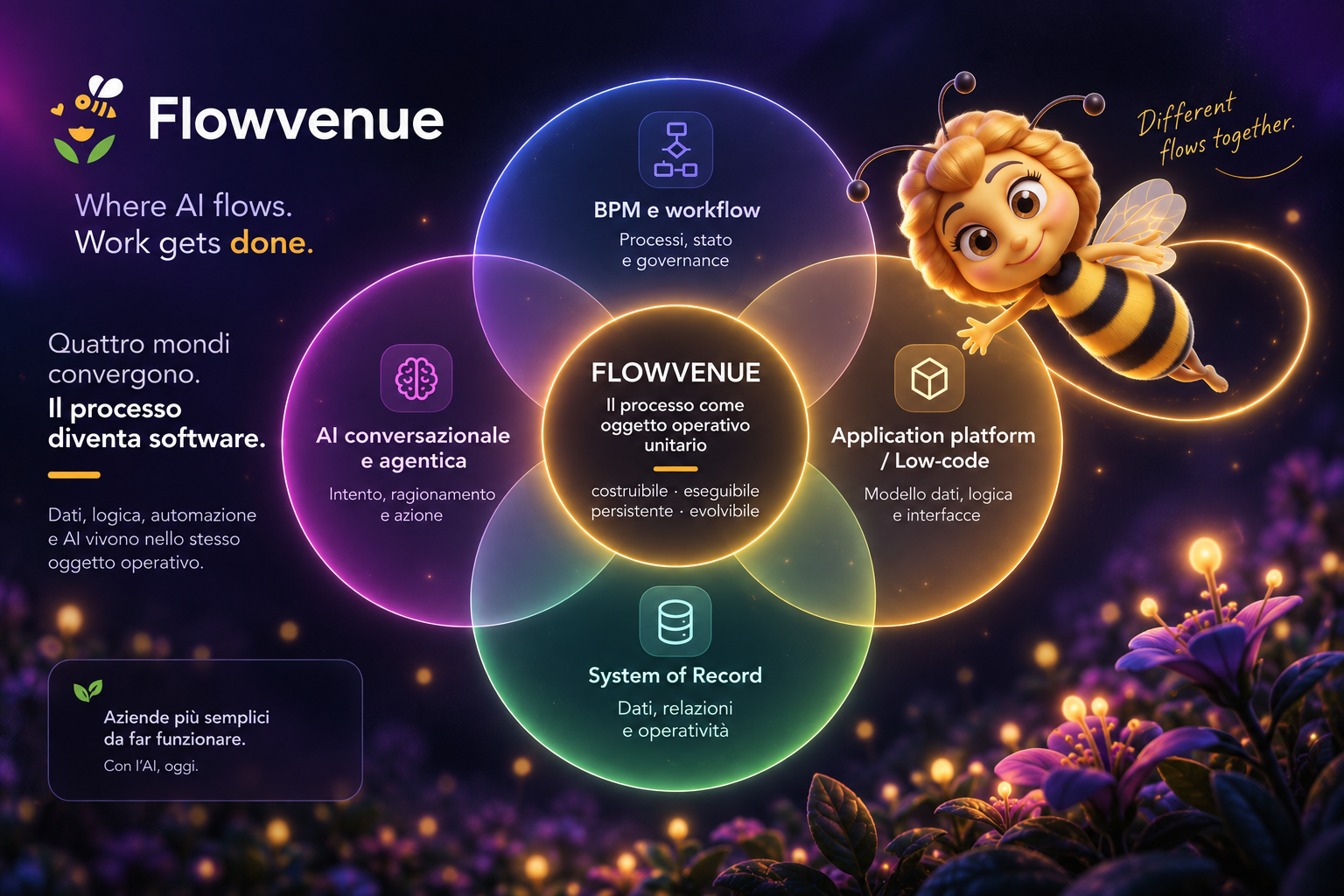
Flowvenue is not a smaller Salesforce. Salesforce is a CRM-centered application platform; Flowvenue is a process-centered operational platform. That distinction changes how replacement should be evaluated.
Why do companies look for Salesforce alternatives?
Reasons vary: simplifying architecture, reducing specialist dependencies, changing how custom processes are built, adopting an AI-native operating model, or simply choosing a CRM that fits better. There is therefore no universal “best Salesforce alternative”.
Separate three needs: replace the CRM; replace the application platform when Salesforce is mainly custom objects, Flow, Apex, UI and integrations; or decouple processes from CRM while Salesforce remains a system of record.
Salesforce is much more than a CRM
A fair comparison must reflect Salesforce's evolution. Flow and Flow Orchestration support automation and complex processes; Apex extends logic; MuleSoft supports integrations; Agentforce and Headless 360 bring Salesforce capabilities to agents and external experiences.
Choosing Flowvenue merely because it “has AI”, “uses MCP”, or can work outside a traditional UI would therefore be a weak distinction. Salesforce already exposes platform capabilities to MCP clients through Headless 360.
When another CRM is the answer
If the problem is fundamentally sales-oriented — pipeline, accounts, contacts, opportunities, forecasting, and sales-team adoption — comparing Salesforce with other CRMs makes sense. The product category remains correct; the vendor changes.
When the problem is no longer CRM
The situation changes when Salesforce has become the place where custom operational processes are built: procurement, onboarding, cases, orders, delivery, approvals, integrations, documents, or cross-functional workflows. Then the question is not only which CRM to choose, but why CRM should remain the central object of the process.
Flowvenue starts from the opposite abstraction. The center is the process instance, with its own state, current requirements, rules, actions, and continuation. Data can live in Flowvenue or in existing systems.
Salesforce vs Flowvenue: CRM-centric vs process-centric
| Salesforce | Flowvenue | |
|---|---|---|
| Central object | CRM / records / application platform | Operational process |
| Processes | Built with Flow, Orchestration and other capabilities | Native executable object |
| State | Can be modeled through records and orchestration | Native to the process instance |
| AI | Agentforce and headless capabilities | Compatible clients interact with the runtime |
| System of record | Salesforce is often central | Can be Flowvenue or an external system |
A Salesforce alternative that does not start from zero
Flowvenue includes a native Salesforce connector: the org's data model can be recreated in Flowvenue with one click, while data can remain synchronized through batch flows. This allows the existing structure to become a starting point instead of manually redesigning every object and relationship.
Process and synchronization setup can also be requested in natural language. The goal is not to copy Salesforce forever, but to lower the initial migration barrier: connect, replicate, synchronize, and progressively make processes independent from CRM.
A third option: keep Salesforce, move processes out of CRM
The decision does not have to be binary. Salesforce can remain responsible for customer data and CRM capabilities while Flowvenue becomes the operational layer for processes spanning Salesforce, ERP, email, documents, people, and AI.
The question to ask before choosing an alternative
Before creating a shortlist of Salesforce competitors, ask: if Salesforce disappeared today, what would we actually need to rebuild? If the answer is mainly CRM pipeline, another CRM is probably appropriate. If the answer is a long list of custom objects, flows, integrations, screens, and processes, a process-centric architecture deserves comparison too.
Conclusion
Looking for a Salesforce alternative does not necessarily mean looking for a cheaper or simpler Salesforce. It can be an opportunity to separate CRM from operational processes. Replacing the CRM changes the product; moving from CRM-centric to process-centric changes how operational software is built.
Frequently Asked Questions
It depends on the requirement. If the main need is CRM, compare other CRMs. If Salesforce is mainly being used for custom processes, automation, objects, and integrations, a process-centric platform such as Flowvenue may be worth evaluating instead of another CRM.
In some scenarios, especially where Salesforce is used as a platform for custom processes. In others, Flowvenue can work with Salesforce while Salesforce remains the CRM system of record.
Flowvenue is not designed as a traditional CRM. It is a Conversational Process Platform centered on operational processes and can manage its own data or orchestrate external systems of record.
Yes. Salesforce can retain accounts, contacts, opportunities, and CRM data while Flowvenue governs cross-system processes involving Salesforce and other systems.
Yes. Flowvenue includes a native Salesforce connector that can recreate the Salesforce data model in Flowvenue with one click and synchronize data through batch flows. Synchronization and processes can also be configured through natural-language requests.