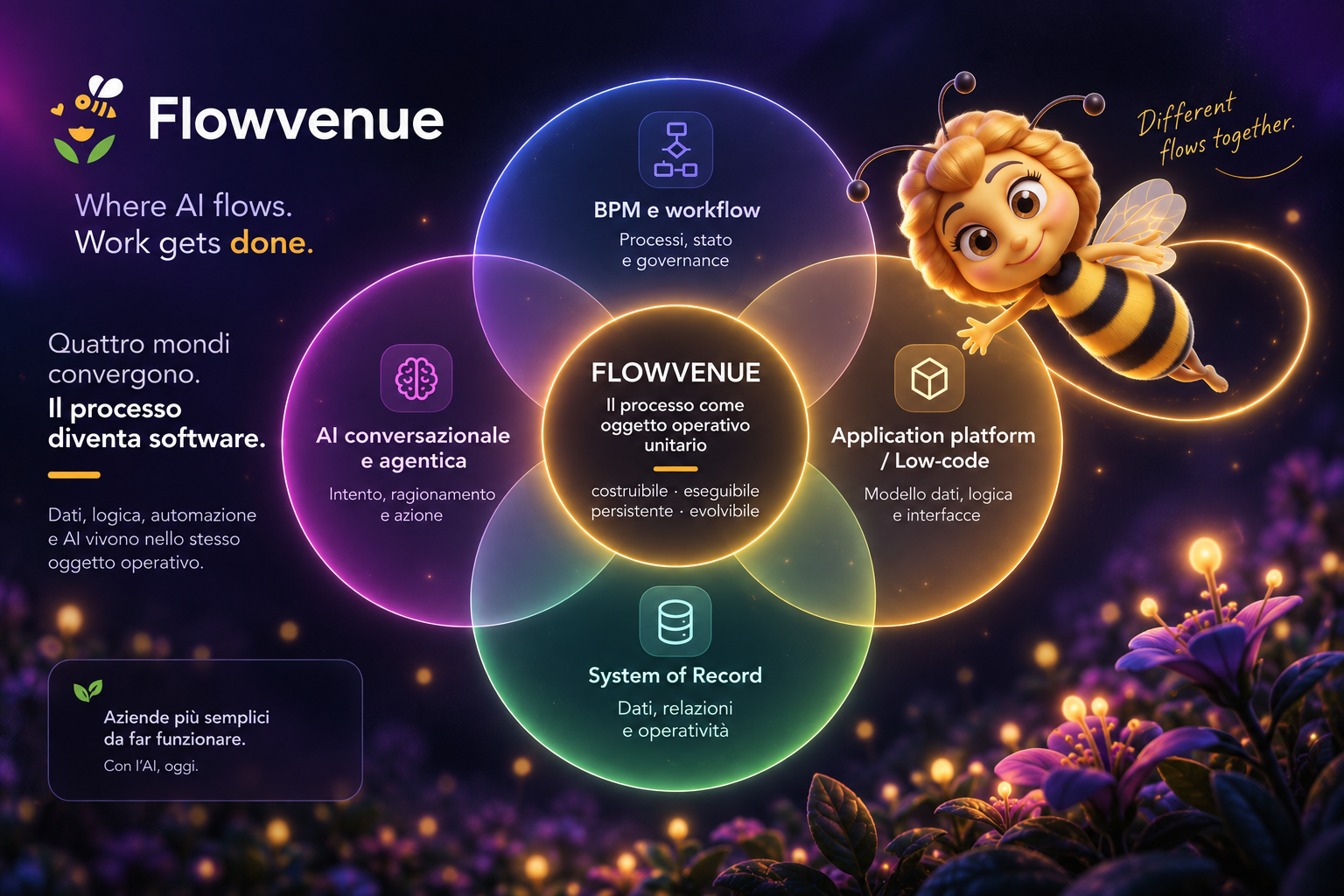
Flowvenue is a Conversational Process Platform: its core object is not the record, the application, the isolated workflow, or the AI agent, but the operational business process. The platform brings together persistent data models, process state, business rules, actions, integrations, and conversational interaction in the same environment. This combination — more than the presence of AI, workflows, or MCP taken individually — is what distinguishes Flowvenue from CRM systems, low-code platforms, BPM suites, and automation tools.
This article compares Flowvenue with the main alternatives companies may consider when they want to turn a real business process into operational software: Salesforce, Microsoft Power Platform, ServiceNow, Mendix, OutSystems, Creatio, Zoho Creator, Quickbase, Kissflow, Airtable, Attio, Retool, Bubble, Zapier, Make, n8n, and Camunda.
In short: what is different about Flowvenue?
Many modern platforms now include AI, automation, databases, APIs, and low-code tools. Saying that “Flowvenue combines AI and workflows” is therefore not enough.
The more specific difference is this: Flowvenue treats the process as a single operational object that is buildable, executable, persistent, and evolvable.
In practice, a process can simultaneously have:
- a data model and persistent records;
- its own process instance and execution state;
- deterministic actions and business rules;
- required fields and requirements that change depending on the current state;
- integrations with APIs and external systems;
- human interactions and approvals;
- AI actions;
- continuity across conversations and different clients.
The goal is not to generate code or to build a traditional application first and then add AI on top. The goal is to move directly from a description of how the company works to an executable operational process.
The practical test: a sales, shipping, and invoicing process
To make the comparison concrete, consider an end-to-end operational process: selling a product with customer and item management, country- and VAT-regime-dependent tax rules, DHL shipment creation, tracking, invoice issuance through an external system, persistent data, and the ability to stop and resume work when information is missing.
A truly comparable system therefore needs to cover at least these layers:
| Layer | Required capability |
|---|---|
| Data model | Customers, products, sales, shipments, invoices, and relationships |
| System of Record | CRUD, queries, history, and persistence |
| Process runtime | State and progression of each individual process instance |
| Business logic | Rules, conditions, required fields, and calculations |
| Integration | APIs to DHL, invoicing systems, and other services |
| Human interaction | Data entry, correction, and approval |
| Operational interface | Visibility and management of work |
| AI | Intent understanding and natural-language interaction |
| Governance | Permissions, auditability, and error handling |
This is the “full-stack process test”: it does not ask whether a platform generically has workflows, but how directly it can turn an end-to-end business requirement into a running process.
Flowvenue vs CRM: Salesforce, Attio, and HubSpot
Modern CRMs such as Salesforce and Attio are increasingly configurable. They can model custom objects, relationships, automations, and integrations. Salesforce adds Flow, Apex, and a broad application platform; Attio offers a flexible data model with custom objects and MCP access that allows AI assistants to work with CRM data.
The natural starting point, however, is still generally the record and the application model. The process is built on top of objects through workflows, automations, rules, or code.
In Flowvenue, record state and process state are separate concepts. A sale can be a persistent record, while the process instance managing it simultaneously has its own current position in the flow, the information required at that point, and the valid continuation.
This matters in long-running or incomplete processes. If a sale has reached the shipping step but a mandatory piece of information is missing, the entire situation does not need to be represented only through a “status” field on the record: the process instance can remain in its operational state and resume later.
Flowvenue vs Microsoft Power Platform
Microsoft Power Platform is one of the most complete alternatives. Dataverse provides the data layer; Power Apps builds applications; Power Automate manages automation and orchestration; Copilot Studio adds agents and AI interaction. Microsoft can also generate end-to-end solutions from natural-language descriptions.
The difference is therefore not “Flowvenue has something Microsoft does not.” The difference lies in how many abstractions must be composed. In Power Platform, a solution may consist of Dataverse tables + apps + flows + connectors + agents. In Flowvenue, these elements are brought back to the process and its native actions.
This is why a useful metric is not the number of features but Time-to-Process: the time between describing the requirement and having a process that actually runs on company data and systems.
Flowvenue vs low-code: Mendix, OutSystems, Zoho Creator, Creatio, Quickbase, and Kissflow
Low-code platforms are probably among the most interesting comparisons. Mendix has a domain model, persistent workflow engine, UI, and agentic capabilities. Zoho Creator can generate data models, forms, workflows, permissions, and blueprints from prompts. Creatio combines data modeling, UI, workflows, process management, and AI. Quickbase and Kissflow can build business applications with data and automation.
These platforms can therefore implement a similar end-to-end use case. The useful distinction is what is being built.
In the traditional low-code paradigm, the requirement tends to become an application: you define the data model, screens, workflows, logic, integrations, and deployment lifecycle. Flowvenue aims to shorten this chain by making the process itself the primary software artifact.
The comparison then becomes: “To put this process into production, how many components do I need to design and how much platform-specific knowledge do I need?” That is more useful than asking “which platform has more features?”
Flowvenue vs Airtable
Airtable combines a flexible system of record, interfaces, and automations and is increasingly close to an application platform. It is especially fast when a problem can be expressed well as structured data, views, and automations.
Flowvenue starts from the operational process instead. The distinction to test is whether work state is represented mainly through records and automations or through an explicit process instance that knows the current point in the process and its continuation.
Flowvenue vs Attio
Attio is a particularly useful comparison because it combines a flexible data model with custom objects, workflows, and MCP access. It can therefore represent entities such as customers, products, transactions, or invoices and allow an AI assistant to read and update data.
Attio remains primarily record-centric: objects, attributes, records, and lists are its foundational model. Flowvenue is process-centric: the record still matters, but the process has its own identity and lifecycle.
A practical question highlights the difference: “Which sales are currently stuck at the Invoicing action because a required field is missing?” In a process-native model, this information belongs directly to the state of process instances; in a record-centric model, it must be represented through attributes, statuses, and automations designed into the data model.
Flowvenue vs Retool and Bubble
Retool offers a managed PostgreSQL database, application builder, workflows, and AI agents. Bubble combines database, UI, and application workflows. Both can therefore build complete systems.
The comparison is mainly about dependency on application-development skills. Retool is explicitly oriented toward building apps and internal tools; Bubble toward building web applications. Flowvenue aims to reduce the need to think in terms of frontend, backend, and application architecture when the problem to solve is fundamentally a business process.
Flowvenue vs Zapier
Zapier can no longer be described simply as an integration tool. Zapier Tables provides data persistence, Interfaces adds an interaction layer, Zap workflows automate actions, and Zapier MCP provides access from AI systems.
The difference to observe is again the operating model: Zapier starts from event-and-action automation; Flowvenue starts from modeling and executing a persistent process. In simple scenarios the difference may be small. It becomes more relevant when the process has many stages, progressive requirements, human-in-the-loop steps, recoverable errors, and long duration.
Flowvenue vs n8n and Make
n8n and Make are powerful automation platforms. Both can orchestrate APIs, AI, and external systems; n8n also provides Data Tables and Make includes data-storage mechanisms.
The distinction is therefore not simply whether they “have a database.” Their natural unit is the automation workflow or scenario. To turn a complex process into a complete operational application, teams often still need to design the data model, operational interface, record lifecycle, permissions, and the way users resume work.
Flowvenue incorporates these concerns into the platform model instead of making automation the only architectural center.
Flowvenue vs Camunda
Camunda is the opposite comparison. It is extremely strong in process runtime: BPMN, process instances, durable orchestration, human tasks, APIs, microservices, and AI agents. It can also expose processes as MCP tools.
Camunda, however, is primarily a process-orchestration platform: it coordinates people, systems, services, and agents. It is not designed as a general-purpose application system of record that replaces the data/application layer of a business system.
Flowvenue aims to bring process runtime and application runtime closer together: the process can operate directly on platform-native objects and persistent data through native primitives, while still orchestrating external systems.
Four categories converge into the same operational object
One simple way to understand Flowvenue's positioning is to look at four software families:
- BPM and workflow: process, state, and governance;
- conversational and agentic AI: intent, reasoning, and action;
- application platforms and low-code: data models, logic, and interfaces;
- systems of record: data, relationships, and operations.
Flowvenue is not interesting merely because it includes capabilities from all four families: several enterprise suites are converging in that direction as well. The distinctive hypothesis is that these capabilities converge into the same operational object: the process.
The process is not just a diagram, not just a sequence of automations, not just an agent, and not just a screen on top of a database. It is buildable, executable, persistent, and evolvable at the same time.
Why can Flowvenue be innovative if the individual technologies already exist?
Innovation in a platform does not require every component to be new. Databases, workflow engines, APIs, LLMs, agents, and protocols such as MCP all exist independently.
The important question is which abstraction becomes the center of the system. In CRM, the center tends to be the record; in low-code, the application; in BPM, the process model and orchestration; in automation tools, the workflow; in agentic systems, the agent and its tools.
Flowvenue chooses the operational business process as the center and makes it directly accessible to AI while keeping state, rules, and continuity in the runtime rather than inside a single conversation.
The process, not the conversation, as the unit of continuity
This principle has a practical consequence. A process can be started by a user through one AI client, pause because information is missing, and continue later from another compatible channel or client. Operational continuity should not depend on the history of the previous conversation: it belongs to the process instance.
The AI interprets intent and interacts with the process; the runtime maintains operational truth: current state, persistent data, rules, and continuation.
Time-to-Process: a different metric from time-to-app
When comparing Flowvenue with larger platforms, one of the most meaningful metrics may be Time-to-Process: how long it takes to move from “this is how I want to work” to “this process is actually running with my data and systems.”
Time-to-Process depends on the concrete use case and cannot be inferred from feature lists alone. A serious comparison should measure at least:
- time from requirement definition to the first end-to-end execution;
- number of components that must be configured;
- need for custom code;
- number and type of specialist skills required;
- time needed to modify the process after go-live;
- ability to resume in-flight instances after a change or interruption.
When should you choose Flowvenue, and when another platform?
Flowvenue is especially aligned with problems where the main value lies in how work moves across people, data, rules, AI, and different systems, particularly when the process changes frequently or must be built quickly without becoming a traditional software project.
Other platforms may be preferable when the requirement already matches their natural center: Salesforce or Attio for strongly CRM-centric scenarios; Microsoft Power Platform for organizations deeply standardized on the Microsoft ecosystem; Camunda for complex enterprise orchestration where application systems already exist; Retool or Bubble when the main goal is to build an application with a specific UI; n8n, Make, or Zapier when the problem is primarily automation and integration.
The point is therefore not that Flowvenue “can do everything and the others cannot.” The point is how directly a business requirement can become an operational, persistent, governed process.
Conclusion
CRM, BPM, low-code, automation platforms, and agentic AI are converging. As a result, differences based on individual features become obsolete quickly.
Flowvenue's thesis is simpler: the business process can become operational software directly. Data, state, rules, actions, integrations, and AI do not necessarily need to be assembled as separate projects around the process; they can belong to the same operational object.
That idea — and above all the time and specialist skills required to move a real process into production — is where a meaningful comparison between Flowvenue and the alternatives should begin.
Frequently Asked Questions
Flowvenue is a Conversational Process Platform that turns business processes described in natural language into executable operational processes by combining persistent data, process state, rules, actions, integrations, and AI.
A CRM is mainly record-centric: the data model and records are central, and workflows are built on top of them. Flowvenue is process-centric: record state and process state are separate, and each process instance can maintain its own state, current requirements, and valid continuation.
Power Platform combines Dataverse, Power Apps, Power Automate, and Copilot Studio to build end-to-end solutions. Flowvenue brings data, logic, integrations, AI, and interaction back to the same operational object: the process, with the goal of reducing the number of components and specialist skills needed to get a process running.
Camunda is primarily a process-orchestration platform that coordinates people, systems, services, and agents through durable processes. Flowvenue brings process runtime and application runtime closer together by also providing an operational data model and native primitives the process can use directly.
It shares automation and integration capabilities with them, but the center is different. n8n, Make, and Zapier were built around workflows and automations; Flowvenue treats the persistent business process as the operational object, including data, state, rules, actions, and continuity.
Flowvenue shares some low-code goals, such as reducing the amount of code required to build business software, but its primary artifact is the operational process rather than the application. The requirement is modeled as an executable and persistent process.
The distinguishing feature is not a single technology such as AI, MCP, databases, or workflows. It is the way these capabilities are brought together around a single operational object: a process that is buildable, executable, persistent, evolvable, and accessible through conversational interfaces.
Time-to-Process is the time required to move from describing a business requirement to having a process that actually runs with data, rules, people, and external systems. It is a useful metric for comparing platforms without relying only on feature counts.
Not necessarily. Flowvenue can maintain its own operational data while also orchestrating external systems. In many scenarios, its role is to become the operational process layer connecting people, AI, and systems that are already in place.
Depending on the problem, alternatives include Salesforce, Microsoft Power Platform, ServiceNow, Mendix, OutSystems, Creatio, Zoho Creator, Quickbase, Kissflow, Airtable, Attio, Retool, Bubble, Zapier, n8n, Make, and Camunda. They do not all belong to the same category: some are CRM systems, others are low-code, BPM, application platforms, or automation tools.