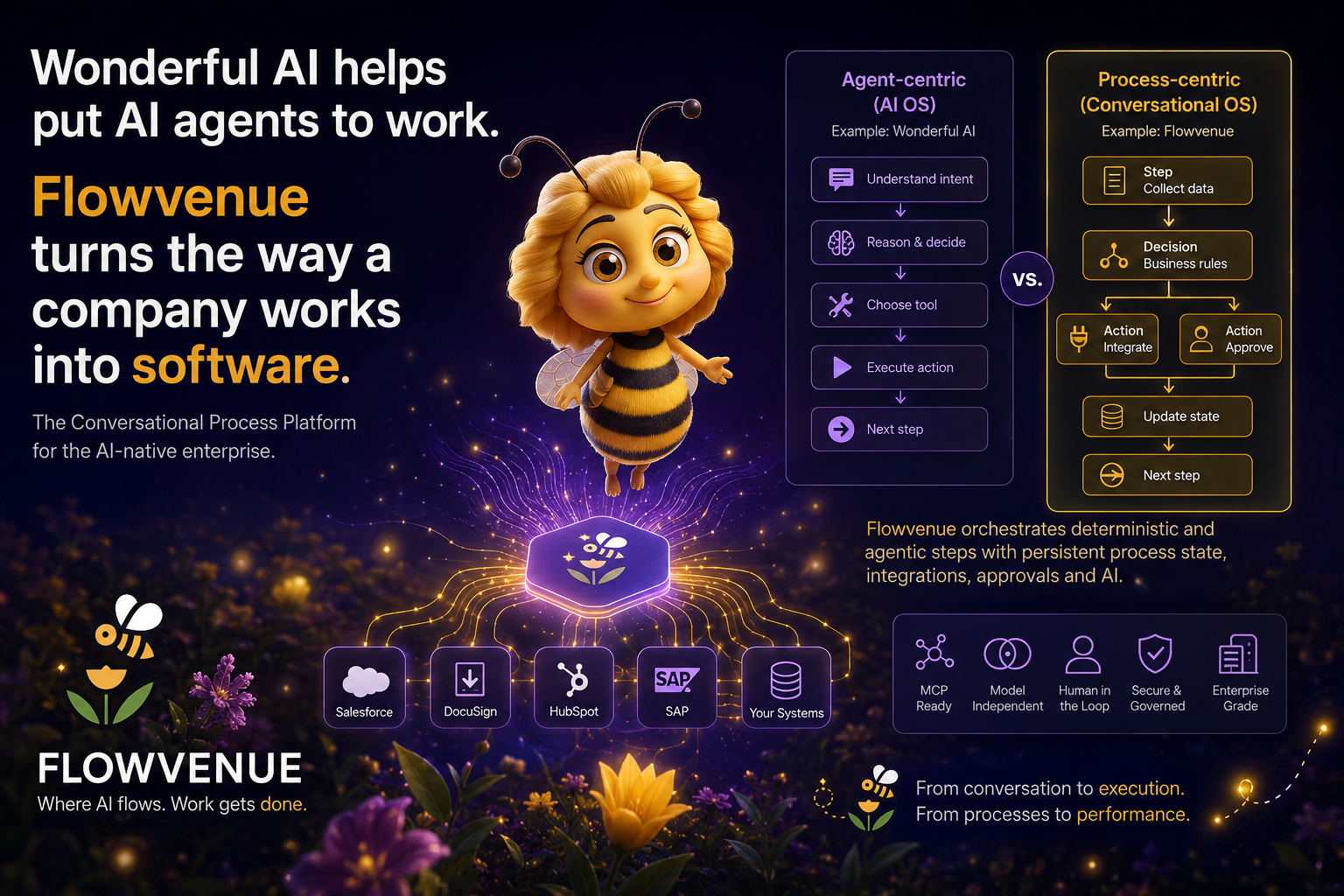
Alternatives to Wonderful AI vary primarily by architectural approach, focusing on agent-centric versus process-centric models. Choosing the right platform depends on your enterprise needs around process persistence, human approvals, integrations, and AI model flexibility.
Understanding Agent-Centric vs Process-Centric Architectures
Wonderful AI adopts an agent-centric architecture, where AI agents act autonomously to manage tasks, make decisions, and interact with users. This model emphasizes flexible, intelligent agents that drive workflows based on interpreted intents and dynamic inputs. While it excels in adaptive intelligence, it can introduce variability in execution and challenges in maintaining consistent process control.
In contrast, Flowvenue is based on a process-centric architecture focused on executable, persistent business processes that apply defined rules, conditions, and workflows deterministically. AI operates within these processes to interpret inputs and propose actions, always guided by process logic and governance rules. This approach reduces the risk of errors or inconsistencies and supports reliable state management over time.
The key trade-off lies in execution style: agent-centric platforms like Wonderful AI prioritize adaptability and intelligence through agentic execution, whereas process-centric platforms like Flowvenue emphasize deterministic execution that follows explicit rules consistently.
Enterprises requiring strict process governance, auditability, and predictable outcomes may prefer a process-centric approach for better control and integration of human approvals. Conversely, if flexibility and agent-driven interactions are paramount, an agent-centric system could be more suitable.
Key Criteria for Evaluating Enterprise AI Process Automation Platforms
Evaluate how platforms handle persistent process state and data context to ensure workflows maintain continuity, reduce errors, and apply rules consistently over time rather than treating interactions as isolated events.
Human approvals within workflows should be configurable to require decision-making on sensitive actions per governance policies, balancing automation with control and compliance.
Integration capabilities are essential; look for platforms that connect seamlessly with existing enterprise systems—ERP, CRM, and communication channels—without complex technical workflows or duplication across channels.
Consider AI model independence and multi-agent cooperation support. Platforms that enable external AI agents like ChatGPT or Claude to leverage a robust process backend provide flexibility and reduce vendor lock-in risks.
These criteria help avoid solutions that treat processes as simple scripts or disconnected agent actions, favoring those that execute structured, reusable business processes with clear governance.
How Flowvenue Differs from Wonderful AI: A Process-Centric Alternative
A fundamental distinction is architectural focus: Wonderful AI centers on autonomous AI agents within an Enterprise AI OS, while Flowvenue is a process-centric platform built around executable business processes with persistent state.
Flowvenue treats each business process as a persistent, executable program—not a static diagram or isolated tasks. Processes maintain their state and data over time, applying rules, conditions, and decision branches consistently. This reduces risks of errors and incoherence common in fragmented or loosely defined workflows.
Flowvenue enables conversational process building and multi-channel execution. Processes are constructed and managed conversationally but run consistently across web chat, WhatsApp, email, and APIs without duplicating logic—unlike agent-centric solutions that may require distinct behaviors per channel.
AI within Flowvenue acts as a core engine inside governed processes, interpreting inputs and proposing actions while respecting governance policies. Human approvals can be incorporated where necessary, ensuring sensitive decisions remain controlled. This hybrid model—deterministic process logic guided by agentic AI—offers transparency and reduces operational risks.
Concrete business examples include automating customer onboarding with multiple steps, validations, and human sign-offs, or orchestrating multi-departmental procurement processes integrating ERP and CRM systems. Preserving process state and enforcing consistent rules is critical in these scenarios.
Choosing between Wonderful AI and Flowvenue depends on whether your enterprise prioritizes agent autonomy and AI-driven decisions, or deterministic, persistent process execution with embedded AI support. Flowvenue’s Model-agnostic Conversational Process Platform (MCP) allows external AI agents like ChatGPT or Claude to run and modify processes programmatically, providing operational backend flexibility. Learn more about Flowvenue MCP Server.
For insights on workflow tool limitations, see why traditional workflows are insufficient.
Concrete Business Scenarios Illustrating Different Platform Strengths
What Is a Conversational Process Platform?
Agent-driven platforms like Wonderful AI excel where workflows demand rapid, adaptive decision-making, such as customer support escalations or real-time sales negotiations. Their autonomous agents interpret context and perform dynamic actions, enabling flexible responses but potentially introducing execution variability.
Industries with strict compliance needs—financial services, healthcare, legal—benefit from Flowvenue’s process-driven platform. Defined as executable programs enforcing rules, conditions, and governance, these processes preserve persistent state and audit trails, reducing risks of errors or inconsistent policy application.
Workflows involving human approvals, such as purchase order authorizations or contract reviews, are supported by Flowvenue’s configurable approval gates, balancing automation efficiency with governance requirements—a level of transparency agent-centric platforms may not provide.
Flowvenue’s multi-channel orchestration enables consistent process logic execution across chat web, WhatsApp, email, and APIs without duplicating workflows, maintaining data integrity regardless of communication channel. See also AI workflow automation.
Its Model-agnostic Conversational Process Platform (MCP) allows AI agents such as ChatGPT or Claude to use its backend as an operational process engine. This separation of concerns offers enterprises flexibility and governance when combining popular AI agents with robust process control.
Evaluating alternatives should consider whether your business values agent-centric adaptability or process-centric predictability and governance. Hybrid approaches may combine agent insights with process-driven workflows to leverage strengths of both.
Common Pitfalls and What to Avoid When Choosing AI Workflow Automation Solutions
Confusing process diagrams with executable processes is a frequent mistake. Visual flowcharts often describe intended actions but lack backends that maintain persistent state, enforce rules consistently, and execute processes in production, leading to operational inconsistencies.
Overreliance on AI without configurable human oversight risks non-compliance. Platforms should allow sensitive decisions to pass through human approvals aligned with governance policies to mitigate risks.
Integration and channel flexibility are often underestimated. Platforms limited to specific channels or lacking multi-channel support may require duplicating logic or restrict user engagement. Prefer solutions that run the same process logic seamlessly across chat web, WhatsApp, email, widgets, and APIs without rewriting workflows.
Finally, governance and versioning capabilities are critical. Without version control and transparent process governance, enterprises risk inconsistent workflows or losing track of changes. Choose platforms treating processes as reusable digital assets with full lifecycle management and approval transparency.
For a broader perspective on AI-driven processes, explore the AI and business process paradigm shift.
Frequently Asked Questions
Agent-centric AI platforms can introduce variability in execution and may lack strict process governance, which can lead to inconsistent outcomes and challenges in compliance.
Enterprises with strict compliance, auditability, and governance needs benefit from process-centric platforms that enforce deterministic rules and persistent process state.
Yes, platforms like Flowvenue support Model-agnostic Conversational Process Platforms (MCP), allowing AI agents such as ChatGPT or Claude to operate processes programmatically.
Avoid platforms that only offer process diagrams without executable backends, disregard human approval configurations, or lack multi-channel support leading to duplicated logic.
Agent-centric platforms excel in workflows requiring rapid, adaptive decision-making and flexible interactions, such as customer support escalations or dynamic sales negotiations.