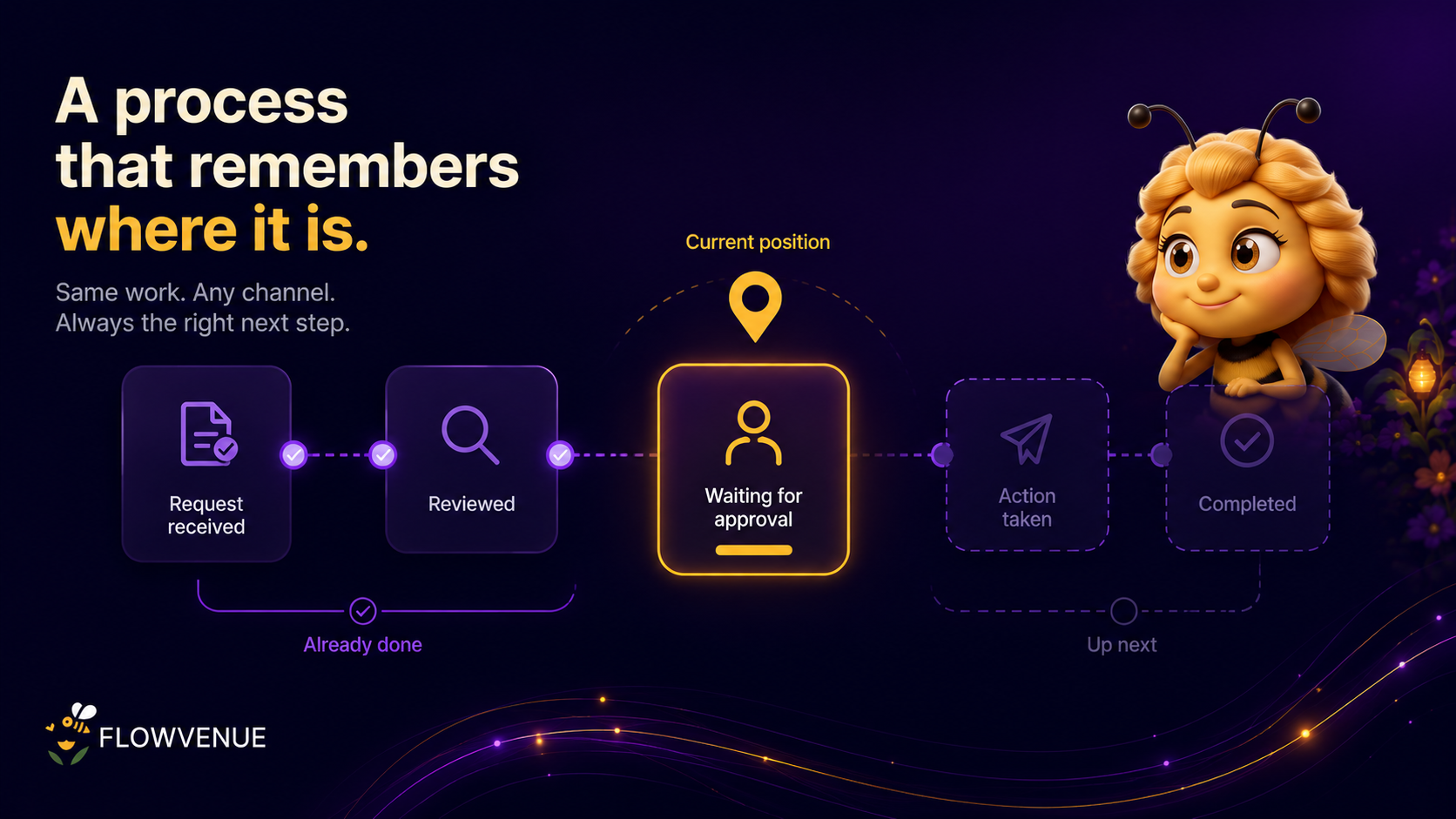
Persistent state means a process remembers where it is, what has already happened, who decided what, and what step comes next — across sessions, across channels, across time. Without it, every interaction with an AI starts from zero, even when the work itself is still in progress.
This is easy to miss because a chat interface feels continuous. The conversation scrolls, the AI remembers what you said five messages ago. But conversation history is not the same thing as process state. One is "what was said." The other is "where the work actually stands."
Why this matters now
Most people's mental model of AI comes from chatbots: you ask, it answers, the exchange is self-contained. That model works fine for a single question. It breaks down the moment a process spans more than one interaction — which is almost every real business process.
A refund request isn't resolved in one message. It gets submitted, checked against a threshold, routed for approval, approved, executed, and logged — often across different people, different tools, different days. If nothing tracks that sequence, each step starts blind: unsure whether the previous one happened, whether someone already acted, whether the request is a duplicate.
This is the gap persistent state is built to close: giving a process a memory that survives longer than a single conversation, independent of which AI or which person is interacting with it at any given moment.
How it's different from things it looks like
It's not chat history. A transcript of what was said is not a record of what was decided or what state something is in. A chatbot can "remember" your last message and still have no idea whether the task you're discussing was completed, skipped, or is still waiting on someone.
It's not a database by itself. Storing data is necessary but not sufficient. A database holds records; persistent state specifically holds where a process currently stands — its position in a defined sequence, not just facts about it.
It's not session memory. Session memory typically resets or fades when you close a tab or start a new conversation. Process state has to survive exactly that — a different person picking up the same request tomorrow, through a different channel, needs to land in the same place the last person left it.
It's not the same as governance. Governance is about rules and approvals — who is allowed to do what. State is what makes governance possible to enforce consistently: you can't apply a rule correctly if the system doesn't know which step is currently active.
How it actually works
A few things have to be true for state to hold up in practice:
- A defined position, not just a log. The process needs an explicit answer to "where are we right now" — not just a history of past events to infer it from.
- Durability across time and channel. The same state has to be readable whether the next interaction happens five minutes later in the same chat, or three days later through a completely different entry point.
- A single source of truth. If the "current step" can be interpreted differently depending on which system or which person is asked, the state isn't actually persistent — it's just distributed guesswork.
- Traceability of how it got there. Knowing the current step matters less if you can't also see what led to it — who acted, when, and what changed as a result.
Put together: the AI can carry the conversation in the moment, but the process itself — not the model, not the chat window — is what keeps track of where things stand.
When it matters — and when it's overkill
What Is a Conversational Process Platform?
Persistent state matters whenever a process takes more than one step to complete, involves more than one person, or can be picked up again after being paused. Onboarding, approvals, multi-step support cases, reconciliation — all of these fail quietly without it, because nothing tells the next step whether the previous one actually happened.
It's unnecessary for genuinely single-turn interactions — a straightforward question with a self-contained answer doesn't need a memory of where it stands, because there's no "where" beyond that one exchange.
What this looks like in practice
The same patterns that show governed execution also show why state has to hold underneath it:
- Payment reconciliation. The state isn't just "reminder sent" or "not sent" — it's whether the match was already confirmed, by whom, and whether a reminder for the same discrepancy was already triggered once before.
- Identity verification in support. The state tracks whether verification already passed in this case, so the same check isn't repeated — or worse, skipped — the next time someone continues the conversation.
- Refund thresholds. The state records that an approval request is currently pending, and for what reason, so a second request for the same case doesn't get created by mistake.
- Commercial terms. The state holds which terms were already proposed and where they stand, so a renegotiation doesn't quietly restart from a blank page.
In each case, what's being remembered isn't just data — it's the process's own position inside a sequence that spans more than one exchange.
Common mistakes
The most common mistake is assuming a good conversational memory (the AI recalling earlier messages well) means the process has state. It doesn't. A model can reference something you said earlier and still have no reliable answer for "has this step actually been completed."
A second mistake is letting state live only inside one channel. If the "current step" only exists inside a specific chat thread, the process breaks the moment someone tries to continue it anywhere else — a different tool, a different person, a different day.
A third is treating state as something you can add later. If a process wasn't designed with an explicit notion of "where it currently stands," retrofitting that after the fact usually means rebuilding the process, not patching it.
Frequently Asked Questions
No. A longer context window means the model can reference more of what was said. It still doesn't guarantee a reliable, explicit answer to where a multi-step process currently stands — that requires the state to be tracked as part of the process definition, not inferred from a transcript.
It means the current position and the relevant history are tracked for as long as the process needs them — which is a design decision, not an automatic side effect of using AI.
That's the intent: if state lives in the process itself rather than inside one model's memory, a different AI system picking up the same case later should be able to read the same position and history.
It shouldn't need to. Checking a defined state is typically faster than reconstructing context from scratch — the value isn't in adding steps, it's in not having to guess.