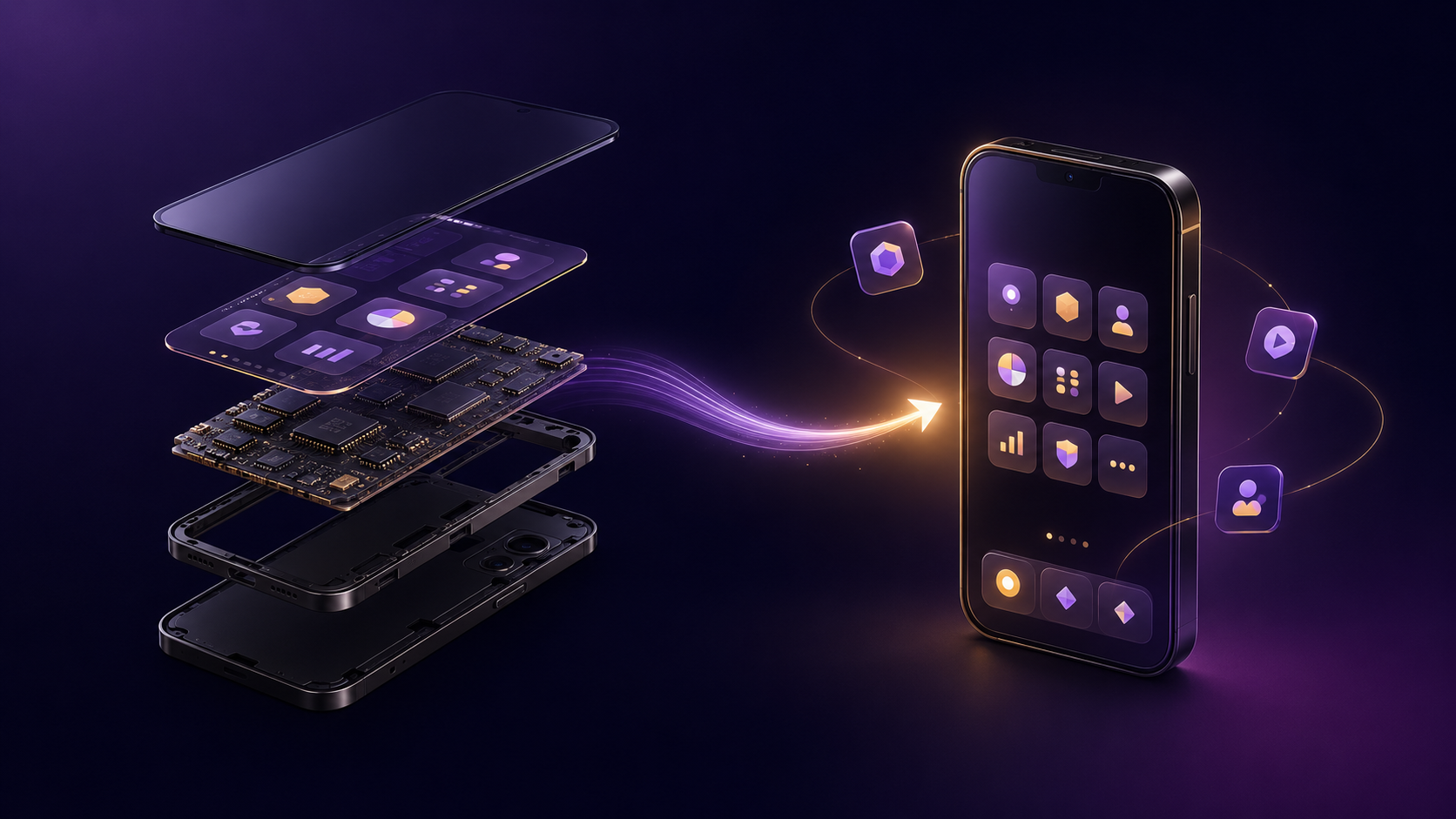
Stop Building Your Smartphone. Start Building Your App.
Why "Vibe Coding" and "Business Vibe Coding" Are Not the Same Thing
Over the past two years, a new way of building software has gone mainstream. You describe what you want in plain language, and an AI writes the code for you. Tools like Lovable, v0, Bolt, and others have made this experience feel almost magical: type a sentence, watch an interface appear.
This is called vibe coding, and it is a genuine breakthrough. It has democratized the first mile of software creation — turning an idea into a working prototype in minutes instead of weeks.
But there's a question most companies don't ask until it's too late: what happens after the prototype works?
That question is the entire reason Flowvenue exists.
The Hidden Cost of Vibe Coding for Business Software
Imagine you ask a vibe coding tool to build something real for your company — not a landing page, but an actual operational system: a lead management flow, an approval workflow, a tool your 20 salespeople will use every day, with real customer data behind it.
The AI happily generates the code. And then you discover that generating code was the easy 10%.
To turn that code into software your business can actually run on, you now need to handle:
- Security — authentication, authorization, data protection, audit trails
- Infrastructure — hosting, scaling, backups, uptime, monitoring
- Data architecture — a real database, not a mock one, with relationships that hold up under real usage
- Permissions — who can see what, who can approve what, role by role
- Maintenance — every dependency, every security patch, every breaking change, forever
- Technical expertise — someone on your team (or an expensive contractor) who understands infrastructure well enough to keep all of the above alive
And here's the part that really stings: you have to do all of this again for the next process you want to automate. There is no accumulation. No reuse. Every new idea starts from zero, on its own island of code, with its own infrastructure to babysit.
There's a simple way to describe what's actually happening: you're not building an app. You're building a smartphone — the hardware, the operating system, the security model, the app store — just so you can install one piece of software.
That's an enormous amount of engineering to ask of a company whose real job is consulting, sales, logistics, or manufacturing — not software infrastructure.
The Smartphone Analogy
Think about how you actually use a smartphone.
You don't build the hardware. You don't write the operating system. You don't implement the security model that protects your data, or the app store that distributes software safely. All of that already exists, engineered once, by people who specialize in exactly that — and it's the same foundation whether you're running a banking app or a game.
What you do is download an app and start using it in minutes.
That's the entire value proposition of a platform: build the hard, general-purpose infrastructure once, so that everyone else only has to solve their own specific problem.
Generic vibe coding tools skip this layer entirely. They're brilliant at generating the "app" — the interface, the interaction, the code — but they hand you the phone in pieces and expect you to assemble it yourself before you can use anything. Great for a weekend project or a marketing microsite. Risky, slow, and expensive for a system your business depends on.
What Business Vibe Coding Means
This is the distinction Flowvenue is built on: Business Vibe Coding.
The "vibe coding" part is the same idea you already love — describe your process in natural language, no need to write a single line of code, no templates to force your business into.
The "business" part is everything that's usually missing: the smartphone is already built.
When you describe a process to Flowvenue — say, "I run a consulting company with 20 salespeople. When a lead comes in, qualify it, assign it to a rep, create an opportunity, and require approval for deals over €50k" — you're not asking an AI to hallucinate a codebase from scratch. You're asking a platform that already has the operating system in place to configure itself around your specific process:
- Data, modeled correctly — leads, accounts, contacts, opportunities — with real relationships between them
- Process, encoded and enforced — qualification logic, approval workflows, commercial assignment rules
- Intelligence, built in — an AI agent that can act inside the process, business rules that govern how it behaves, permissions that decide who can do what
Security, infrastructure, data integrity, and access control aren't things you build. They're the foundation you inherit the moment you start describing your business — the same way every app on your phone inherits the same secure, reliable operating system underneath it, without ever having to think about it.
You don't build the phone. You build the app that runs on it. And the store already has processes ready to install — lead qualification, approval workflows, commercial routing — the operational equivalent of downloading an app instead of engineering one.
Why This Distinction Matters More Than It Sounds
It's tempting to see this as a branding exercise — two products, two taglines. It isn't. It reflects two fundamentally different bets about where software creation is heading.
The vibe coding bet: AI makes writing code so cheap that everyone can build their own custom software from scratch, every time, for every need.
The Business Vibe Coding bet: the code was never really the hard part — the operational reliability underneath it is. So the highest-leverage move is to make that layer disappear, and let AI focus entirely on translating business intent into a working system on top of it.
The first bet gives you a faster way to prototype. The second gives you a faster way to operate.
Companies don't fail because they lack good ideas for process automation. They fail because turning those ideas into secure, reliable, maintained software has historically required a phone's worth of engineering just to get started.
Business Vibe Coding removes that requirement. Not by making coding faster — but by making it unnecessary for the business itself to own.
The Bottom Line
If you're a company trying to automate how you work, ask yourself which problem you actually want to solve: your customer's problem, or the problem of building and maintaining the infrastructure to solve it.
Generic vibe coding tools are excellent at generating an app's surface — and they leave you responsible for the phone underneath. Flowvenue is the phone, already built, already secure, already running — with an app store of business processes ready to configure and extend, so you can go straight to building yours.
Describe how your company works. Flowvenue turns it into software that works.
No developers. No infrastructure to manage. No starting from zero.
That's not vibe coding. That's Business Vibe Coding.