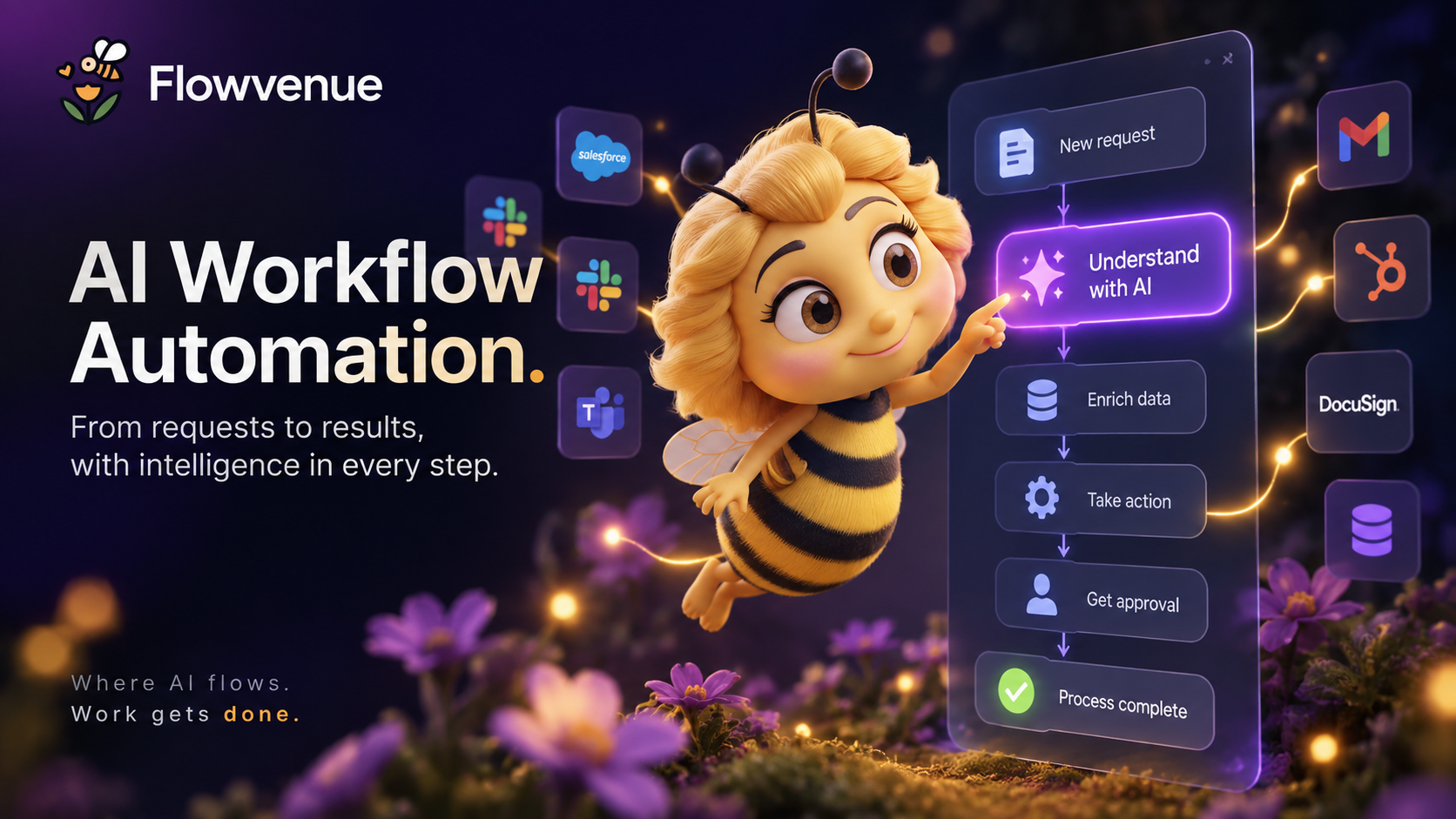
AI workflow automation is the use of artificial intelligence within automated business workflows to interpret information, make contextual decisions, handle exceptions, and assist process execution while deterministic rules continue to govern predictable or sensitive actions.
Unlike traditional workflow automation, which primarily follows predefined rules and paths, AI workflow automation introduces capabilities such as reasoning, classification, natural-language understanding, and contextual interpretation. This allows business processes to work with unstructured information and situations that cannot always be anticipated when the workflow is designed.
The goal is not to replace deterministic automation with AI. In most enterprise environments, the most reliable approach combines both: rules control what must remain predictable, while AI handles the parts of a process that require interpretation, flexibility, or contextual reasoning.
What Is AI Workflow Automation?
AI workflow automation combines traditional process automation with artificial intelligence capabilities inside a defined business workflow.
A traditional workflow might evaluate conditions, update records, call APIs, request approvals, send notifications, or move a process from one predefined step to another. AI extends this model by allowing individual parts of the workflow to interpret natural language, classify information, analyze context, extract meaning from documents, recommend actions, or help manage exceptions.
This distinction is important. AI workflow automation does not necessarily mean that an AI agent controls the entire business process. The underlying workflow can remain structured and governed while AI is used selectively where reasoning adds value.
For example, an order-to-invoice workflow can use deterministic rules to calculate taxes, validate mandatory fields, create shipments, and generate invoices. AI can intervene when an incoming order contains unstructured information, when customer data is incomplete, or when an exception requires interpretation before the process can continue.
How AI Workflow Automation Works in Practice
AI workflow automation works by combining an executable process with AI capabilities at specific points in its lifecycle.
The process defines the structure of the operation: its data, steps, conditions, actions, integrations, approvals, and execution rules. AI can then participate where information needs to be interpreted or where a predefined rule alone is not sufficient.
Typical AI capabilities within an automated workflow include:
- Natural-language understanding: interpreting requests received through email, chat, forms, or other conversational interfaces.
- Classification: categorizing documents, requests, leads, tickets, or business cases.
- Information extraction: identifying relevant data inside documents or unstructured messages.
- Contextual reasoning: evaluating available information to recommend or select an appropriate next action.
- Exception handling: analyzing situations that do not match the standard workflow path.
- Tool use: interacting with APIs, databases, CRM systems, ERP platforms, document systems, and other enterprise applications.
- Human-in-the-loop collaboration: collecting information or preparing recommendations before requesting approval from an authorized person.
For example, in an order-to-invoice process, AI could identify missing customer information and request it conversationally. Once the required information is available, deterministic process logic can validate the order, calculate the correct values, create a shipment through a logistics API, and generate an invoice through an accounting platform.
In this model, AI provides flexibility where flexibility is useful, while the process provides consistency where consistency is required.
AI Workflow Automation vs Traditional Workflow Automation
The main difference between traditional workflow automation and AI workflow automation is how they handle uncertainty and unstructured information.
Traditional workflow automation works particularly well when inputs, conditions, and expected outcomes can be defined in advance. A workflow can follow rules such as: if a payment is confirmed, advance the order; if an amount exceeds a threshold, request approval; if mandatory information is missing, stop the process.
This deterministic model provides predictability and is often the best solution for activities involving calculations, compliance rules, permissions, financial operations, or other actions where the same input should consistently produce the same result.
AI workflow automation adds an interpretation layer. Instead of requiring every input to match a predefined structure, AI can help understand what the information means before the deterministic process continues.
For example, a traditional workflow may require a customer request to contain specific structured fields. An AI-enabled workflow can interpret a natural-language email, identify the relevant information, classify the request, and pass structured data to the next process step.
The two approaches are therefore complementary rather than mutually exclusive.
AI Workflow Automation vs AI Agents and Agentic Process Automation
AI workflow automation, standalone AI agents, and Agentic Process Automation (APA) are related concepts, but they describe different levels of AI participation in business execution.
AI workflow automation introduces AI capabilities within a workflow whose broader structure remains defined. AI can interpret information, classify inputs, reason about context, use tools, and manage selected exceptions while the process continues to provide its operational framework.
AI agents can reason, plan, use tools, and perform actions toward a goal. However, a standalone AI agent does not automatically provide the persistent process state, business rules, approvals, governance, and lifecycle management required for enterprise process execution.
Agentic Process Automation extends automation by allowing agentic AI to participate more actively in multi-step process execution. Depending on the implementation and the guardrails provided, agents may plan actions, select tools, adapt their approach to changing conditions, and coordinate multiple activities toward a business objective.
The distinction can be summarized as follows:
| Capability | Traditional Workflow Automation | AI Workflow Automation | Agentic Process Automation |
|---|---|---|---|
| Deterministic rules | Core capability | Core capability | Can be combined with agentic execution |
| Natural-language understanding | Typically no | Yes | Yes |
| Classification and extraction | Rule-based | AI-assisted | AI-assisted |
| Contextual reasoning | Limited | Yes, within the workflow | Yes |
| Autonomous planning | No | Limited or optional | Core agentic capability |
| Dynamic tool selection | Predefined | Usually controlled | Can be dynamic within guardrails |
| Human approvals | Yes | Yes | Yes, depending on governance |
| Exception handling | Predefined paths | AI-assisted | Agentic and adaptive within defined constraints |
AI workflow automation is therefore useful when organizations want to add intelligence to structured processes without making the entire execution autonomous. Agentic Process Automation becomes relevant when processes require greater autonomy, planning, tool selection, and adaptation across multiple steps.
For a deeper explanation of this evolution, read What Is Agentic Process Automation (APA)?.
When to Use Deterministic Rules Instead of AI
Adding AI to every step of a workflow is rarely the best automation strategy.
Deterministic rules remain preferable whenever an action must be predictable, reproducible, auditable, or strictly compliant with business policy. Examples include mathematical calculations, permission checks, tax rules, mandatory validations, contractual constraints, and actions that trigger irreversible financial or operational consequences.
AI becomes useful when the process encounters information that cannot be efficiently handled through predefined conditions alone.
A practical design principle is:
- use deterministic rules for what the organization already knows how to define precisely;
- use AI for interpretation, classification, reasoning, and unstructured information;
- use human approval where accountability or risk requires a person to make the final decision;
- use agentic capabilities where planning and adaptive multi-step execution provide meaningful operational value.
This hybrid architecture reduces unnecessary AI variability while preserving the flexibility that makes AI valuable in complex business processes.
Practical Examples of AI Workflow Automation
AI workflow automation can be applied across many enterprise processes where structured execution and contextual interpretation need to work together.
Order-to-invoice
An order-to-invoice workflow can receive an order, validate customer and product information, create a shipment, and generate an invoice. AI can interpret unstructured order requests, detect missing information, classify exceptions, or request clarification. Deterministic rules can continue to control pricing, taxes, mandatory validations, shipment creation, invoicing, and approvals.
CRM and customer operations
AI can interpret customer communications, classify intent, identify relevant CRM records, summarize interactions, prioritize requests, and recommend follow-up actions. The workflow can then apply business rules to determine what actions are allowed and which require human confirmation.
Document processing
AI can extract and interpret information from contracts, invoices, forms, emails, and other unstructured documents. The workflow can validate extracted information, compare it with enterprise data, request missing information, route the document for approval, and persist the result.
Enterprise approvals
AI can collect relevant information, summarize a case, identify anomalies, and prepare a recommendation. Deterministic rules can determine who is authorized to approve the request and whether additional controls are required.
Customer onboarding
AI can interpret submitted documents and communications while the workflow coordinates identity checks, data collection, CRM updates, approvals, external integrations, and onboarding tasks.
Across these examples, the value does not come from replacing the workflow with AI. It comes from allowing AI and deterministic process execution to handle the parts of the operation for which each is best suited.
How to Evaluate AI Workflow Automation Tools and Platforms
When evaluating AI workflow automation tools or an AI workflow automation platform, organizations should look beyond the presence of generative AI features.
The more important question is whether the platform can reliably execute real business processes while controlling how AI participates in them.
Key capabilities to evaluate include:
- Executable workflows: Can the platform actually execute the business process, or does it primarily model and visualize it?
- Persistent process state: Can it remember what has happened, what is currently pending, and what needs to happen next?
- AI reasoning: Can AI interpret information and manage exceptions inside the process?
- Deterministic controls: Can critical business rules remain predictable and independent from AI reasoning?
- Human approvals: Can sensitive actions require explicit authorization?
- Enterprise integrations: Can the workflow interact with CRM, ERP, accounting, logistics, document systems, databases, and external APIs?
- Governance and permissions: Can organizations control what users and AI systems are allowed to access, decide, and execute?
- Auditability: Is execution history preserved so organizations can understand what happened and why?
- Multi-channel execution: Can the same underlying process be accessed through different interfaces without duplicating its business logic?
For complex enterprise use cases, it is particularly important to distinguish between platforms that primarily help design automation and platforms capable of maintaining and executing a persistent business process over time.
From AI Workflow Automation to Executable Business Processes
As AI becomes more deeply integrated into enterprise automation, the workflow itself becomes increasingly important.
A business process is more than a diagram or a sequence of AI-generated actions. To support real operational execution, it may need to preserve its own data, state, rules, permissions, integrations, approvals, actions, and execution history.
This leads to the concept of an executable business process: a persistent digital asset that can continue operating independently from the interface used to access it.
This distinction becomes especially important as organizations adopt multiple AI assistants, agents, models, and communication channels. If business logic exists only inside an individual AI agent or interface, changing that interface can require rebuilding part of the operational system.
If the process exists independently, the same business logic can instead be exposed to different interfaces while preserving its rules and state.
This is the architectural idea behind a Conversational Process Platform (CPP).
In a Conversational Process Platform, AI is not the business process itself. AI acts as a conversational and reasoning layer through which people and other AI systems can create, query, and execute governed business processes.
Flowvenue follows this model by allowing organizations to build executable processes with persistent state, deterministic rules, AI actions, integrations, approvals, and permissions, and then make those processes accessible through conversational interfaces and external AI systems.
The underlying process remains the stable operational layer while the AI interface can evolve independently.
This creates a progression from traditional automation toward more intelligent and flexible process execution:
Workflow Automation → AI Workflow Automation → Agentic Process Automation → Executable Business Processes.
The objective is not maximum AI autonomy. It is to use the appropriate combination of deterministic execution, AI reasoning, agentic capabilities, and human judgment for each part of the business process.
Frequently Asked Questions
AI workflow automation is the use of artificial intelligence within automated business workflows to interpret information, make contextual decisions, handle exceptions, and support process execution. It combines AI capabilities such as natural-language understanding, classification, reasoning, and tool use with deterministic business rules, integrations, and human approvals.
AI workflow automation adds AI capabilities to specific steps of an executable workflow. AI can interpret unstructured information, classify requests, extract data, reason about context, or handle exceptions, while deterministic rules continue to control predictable actions such as validations, calculations, permissions, integrations, and mandatory approvals.
Traditional workflow automation primarily follows predefined rules, conditions, and process paths. AI workflow automation adds the ability to interpret natural language, unstructured data, context, and exceptions that cannot always be anticipated in advance. The two approaches are complementary: deterministic automation provides predictability, while AI provides flexibility and contextual reasoning.
AI workflow automation typically uses AI within a defined workflow to interpret information, classify inputs, reason about context, and manage selected exceptions. Agentic Process Automation gives AI agents a more active role in multi-step execution, potentially including planning, tool selection, and adaptive actions within defined guardrails. APA therefore represents a more agentic form of process automation rather than simply adding AI capabilities to individual workflow steps.
Common examples include order-to-invoice processes, customer onboarding, CRM operations, document processing, procurement, support workflows, and enterprise approvals. AI can interpret emails or documents, identify missing information, classify requests, and recommend actions, while deterministic workflow logic controls integrations, calculations, permissions, approvals, and other predictable operations.
AI workflow automation tools should be evaluated on more than their generative AI features. Important capabilities include executable workflows, persistent process state, AI reasoning, deterministic business rules, human approvals, enterprise integrations, permissions, auditability, exception handling, and the ability to control what AI can access, decide, and execute.
An AI workflow builder is a tool that helps users create automated workflows using AI capabilities, natural language, or both. Depending on the platform, AI may help design the workflow, generate individual steps, interpret information during execution, or interact with external tools. For enterprise processes, the ability to execute, govern, and preserve the state of the resulting workflow is as important as how easily it can be created.
An AI workflow automation platform focuses on automating workflows enhanced by AI capabilities. A Conversational Process Platform focuses on the business process itself as a persistent, executable, and governed digital asset. In a CPP, AI can create, query, and participate in process execution, while the underlying state, rules, approvals, integrations, permissions, and execution history remain independent from the AI interface.